

Executive Summary
- Volume vs. Intent: Use CPM for Brand Awareness and Retargeting (Top/Bottom Funnel). Use CPC for Lead Capture (Middle Funnel).
- The “Cheap Click” Trap: Low CPC often correlates with low conversion rates. Always optimize for CPL (Cost Per Lead), not click cost.
- The Golden Ratio: Your LTV:CAC ratio must remain above 3:1 for sustainable growth. Use our calculator below to find your max bid.
Paid advertising teams often face a critical choice: Do you chase low-cost clicks (Low CPC) to fill the top of the funnel, or do you pay a premium for high-cost impressions (High CPM) to reach a more exclusive audience? Most beginners choose the cheap clicks. The experts know better.
In 2026, optimizing for the lowest cost per click is often a trap. It leads to “junk volume”—thousands of visitors who bounce immediately, bloat your CRM, and ruin your sales team’s efficiency. This guide explains the mathematical trade-off between CPM and CPC. We will show you how to ignore vanity metrics and optimize for the only thing that matters: Profit.
Table of Contents
The Decision Matrix: Value vs. Volume
Stop asking “Which is cheaper?” and start asking “What am I buying?”
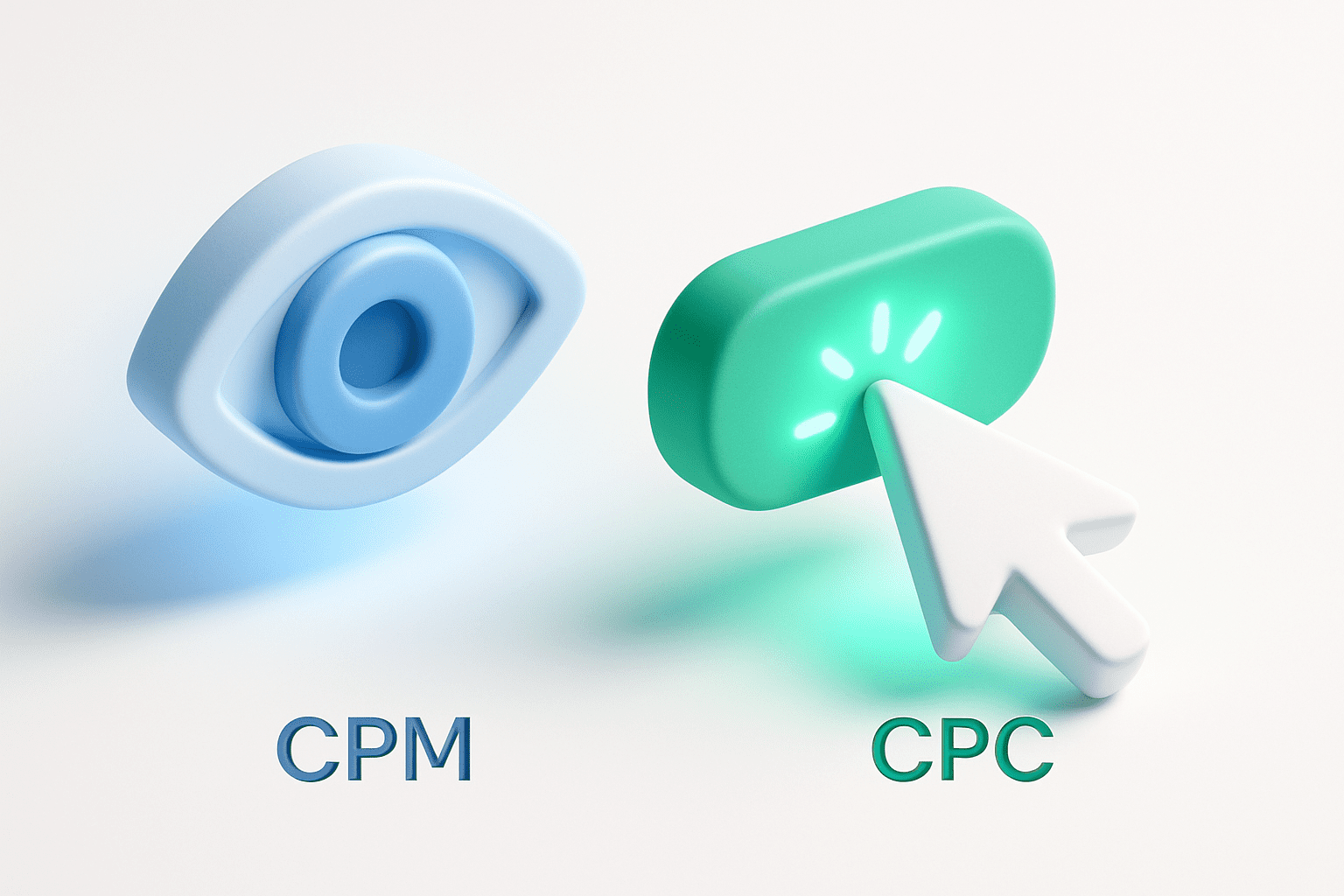
- CPM (Cost Per Mille): You are buying Reach. You pay for the privilege of being seen by a specific human, regardless of action.
- CPC (Cost Per Click): You are buying Traffic. You pay only when someone visits, minimizing upfront risk but often sacrificing audience quality.
Use this framework to decide instantly:
| Goal | Best Model | Why? |
|---|---|---|
| Brand Awareness | CPM | You need to saturate a market. Clicks don’t matter; mental availability does. |
| Niche B2B (ABM) | CPM | The audience is tiny (e.g., “500 CEOs”). You pay a premium to ensure they all see it. |
| Direct Response | CPC | You need immediate sales. You want the platform to take the risk on the creative. |
| Retargeting | CPM | The user already knows you. You just need to remind them to convert. |
The Strategy: How to Combine Them Text
Effective marketing isn’t about choosing CPM or CPC; it’s about knowing exactly when to use them in the buyer’s journey.
We recommend the ‘Sandwich Strategy’: wrap your high-intent CPC campaigns with broad CPM coverage at the top (for awareness) and bottom (for retargeting) of the funnel.
The “Sandwich” Bidding Strategy
“Sandwich” your expensive CPC campaigns with broad CPM coverage.
The “Cheap Traffic” Trap: A Financial Analysis
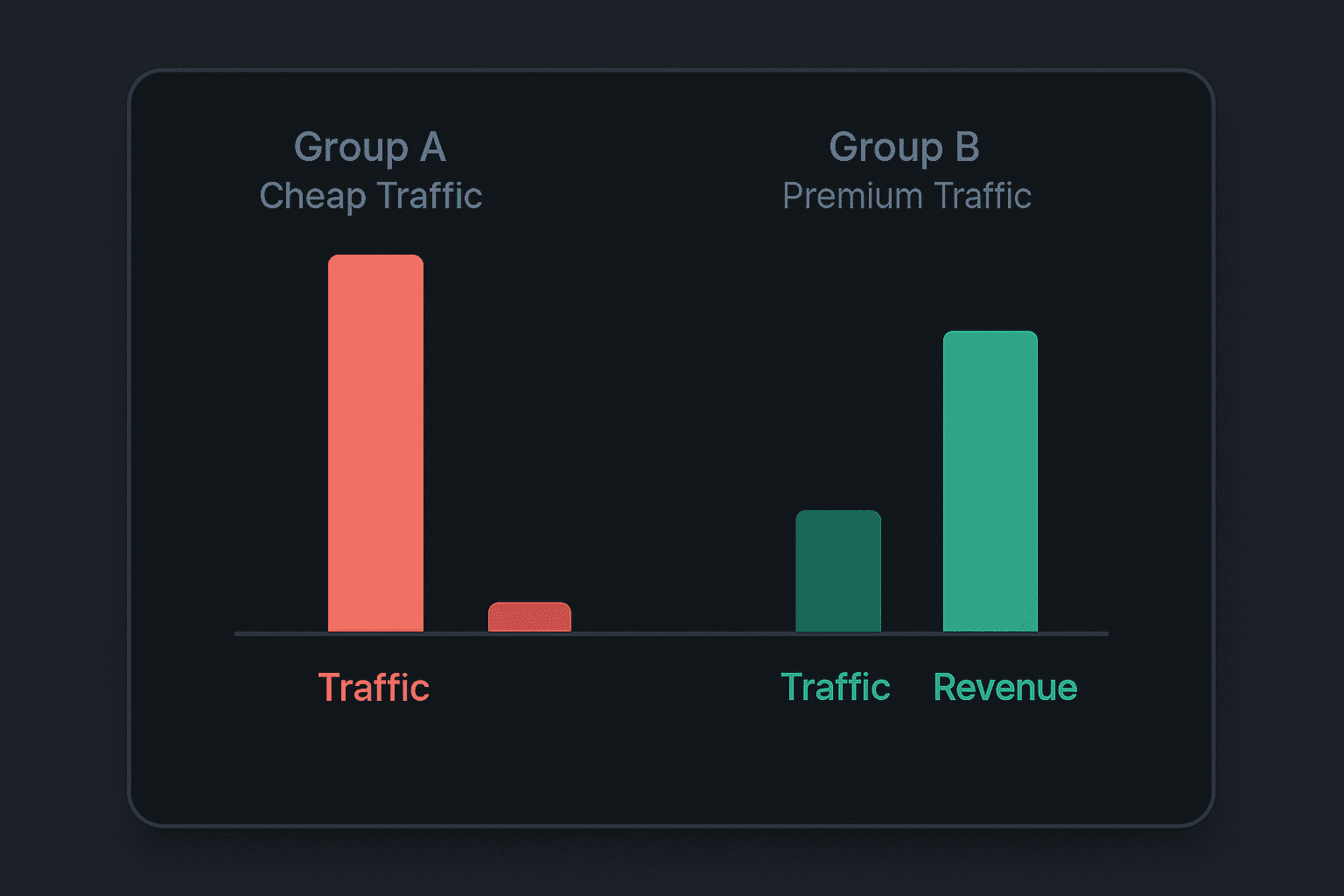
It is tempting to look at a report and celebrate a $0.15 CPC. But in digital marketing, you get what you pay for.
Low CPC usually correlates with Low Intent. When you force an algorithm to find “cheap clicks,” it finds them in the lowest-value corners of the internet (accidental clicks, mobile gaming apps, or bot-heavy placements). According to data from CHEQ, up to 40% of traffic from low-quality ad networks can be invalid or non-human.
The Math: Scenario A vs. Scenario B
Let’s look at two hypothetical campaigns spending $1,000:
| Metric | Scenario A (“Efficient”) | Scenario B (“Expensive”) |
|---|---|---|
| CPC | $0.20 | $2.00 |
| Traffic | 5,000 Visitors | 500 Visitors |
| Conversion Rate | 0.2% (Low) | 5.0% (High) |
| Total Leads | 10 | 25 |
| Cost Per Lead (CPL) | $100 | $40 (Winner) |
The Verdict: The “expensive” traffic delivered leads for 60% less cost. The media buyer chasing the $0.20 click actually lost the company money.
Strategic Note: This dynamic is crucial when targeting Tier 3 countries. Read our Ultimate Guide to Geo-Arbitrage Marketing to see how we balance low costs with high intent to avoid the “junk traffic” trap.
The “Quality Tax”: Why You Should Pay High CPMs
Higher CPMs are often the “tax” you pay to filter out noise. If you target “Business Owners in New York,” your CPM might be $45.00. If you target “Everyone in the USA,” your CPM might be $8.00.
The $45.00 CPM scares away beginners. But the “Business Owner” audience has a Customer Lifetime Value (CLTV) of $10,000, while the generic audience has a CLTV of $50.
The Rule: Accept a higher CPM only if the conversion probability multiplied by the CLTV justifies it.
The Break-Even Formula
Don’t guess. Calculate your “Max Profitable CPM” using this formula. If your actual CPM is lower than this number, you are profitable—regardless of how “expensive” it looks.
| Metric | Formula (Click to Copy) | Benchmark |
|---|---|---|
| CPL (Cost Per Lead) | Total Spend / Leads
| $50 – $150 |
| CAC (Acquisition Cost) | Total Spend / New Customers
| < 30% of LTV |
| Lead Velocity | Growth of Qualified Leads MoM
| +10% |
| LTV:CAC Ratio | Lifetime Value / Acquisition Cost
| 3:1 or higher |
- Target CPA: What you can afford to pay for a sale.
- Conversion Rate: Your landing page performance.
- CTR: Your ad relevance.
The “Vanity Metric” Trap
Stop optimizing for Low CPC.
We have seen campaigns with $0.50 CPCs that generated zero revenue because the traffic was low quality (bots or accidental clicks).
Always measure success by CPL (Cost Per Lead) or ROAS (Return on Ad Spend). A $5.00 click that converts is infinitely cheaper than a $0.50 click that bounces.
⚡ The 10-Second Cheat Sheet
SAVE THISModern Context: AI & Smart Bidding
In 2026, you rarely set manual bids. Google’s Smart Bidding and Meta’s Advantage+ handle the CPM/CPC toggling for you.
So why does this guide matter?
Because the algorithm needs Guardrails. If you set a campaign to “Maximize Clicks” (optimizing for Low CPC), you are explicitly telling the AI to find the cheapest, lowest-quality users it can find. It will flood your site with bots.
The Fix:
- Don’t optimize for Clicks (CPC). Optimize for Conversions or ROAS.
- Monitor the CPM trend.
- If CPM spikes 200%: Your audience is too small or fatigued.
- If CPM crashes: The algorithm may have expanded into “Audience Network” junk inventory.
Tactical Checklist: Optimizing Without Sacrificing Quality
You can lower your costs without buying junk traffic. Here is the operational checklist for your media buyer.
1. Improve Ad Relevance (The “Quality Score” Hack) Platforms like Google and Meta discount your CPC if your ad has a high Click-Through Rate (CTR). Better creative = Cheaper clicks.
- Action: Test 3 distinct headlines every week.
2. Exclude the “Waste Zones” High CPM is fine, but wasted CPM is not. Aggressively exclude mobile apps (gaming), unknown devices, and irrelevant geographic regions.
- Action: Check your “Placement Report” weekly and block the bottom 20% of performers.
3. The Landing Page Feedback Loop If you are paying high CPCs for premium traffic, your landing page must load in under 2 seconds.
- Action: A slow page wastes your premium bid.
The Metrics That Actually Matter (Cheat Sheet)
Stop reporting CPC to your boss. Report these instead to prove true business value. Benchmark data suggests B2B industries see significantly higher costs, making efficiency critical (Source: WordStream Industry Benchmarks).
| Metric | Formula | Benchmark (B2B SaaS) |
|---|---|---|
| CPL (Cost Per Lead) |
Total Spend / Leads | $50 – $150 |
| CAC (Cost Acquisition) |
Total Spend / New Customers | < 30% of LTV |
| Lead Velocity |
Growth of Qualified Leads MoM | +10% |
| LTV:CAC Ratio |
Lifetime Value / Acquisition Cost | 3:1 or higher |
Conclusion: Value Over Volume
Cheap traffic is a vanity metric. It feels good to get 10,000 clicks for pennies, but if those clicks don’t convert, you are just lighting money on fire.
Your New Strategy:
- Define your Target CPA based on your profit margins.
- Ignore the CPC if the ROI is positive.
Use Audience Exclusions to filter out the junk, rather than bidding low to avoid it.